Bauer 707 AM Broadcast Transmitter
Following donation of the 1970s radio studio equipment to the Texas Broadcast Museum (see the blog), a search commenced for the next big project. Restoring a classic radio transmitter had been on the “planned project” list for some time, but no suitable (or practical) candidate could be found. Recently, however, a nearby station was looking to clear out space and get rid of gear that had been sitting around unused for years (or more likely decades). Among the items in the transmitter building was a Bauer 707 AM transmitter.
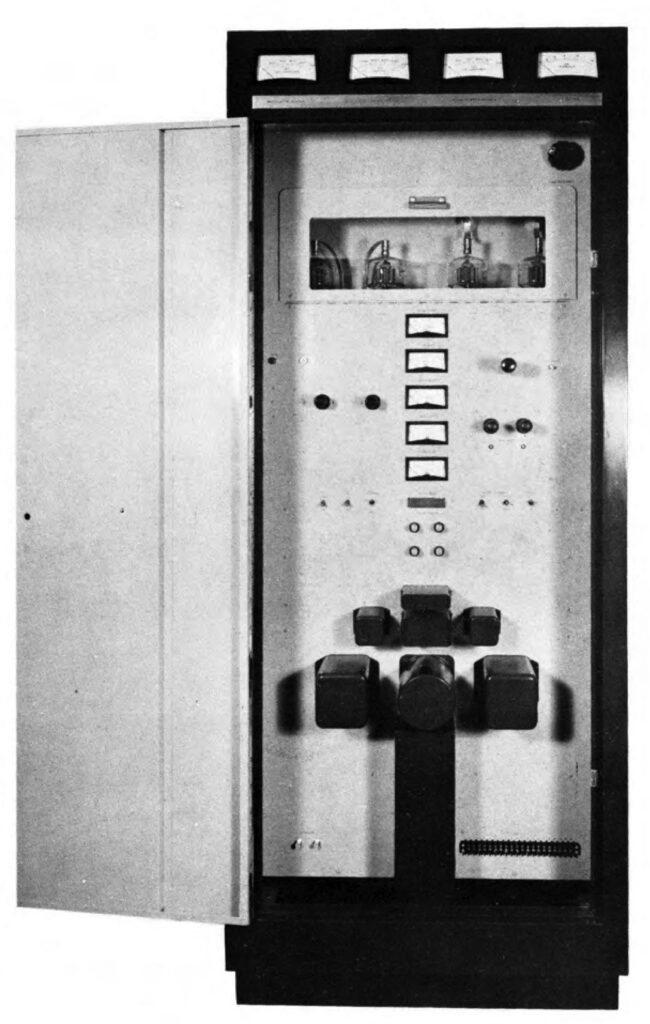
The Bauer 707 employs high-level modulation and can operate on any carrier frequency in the range from 540 kHz to 1600 kHz. With modifications, operation can be extended to 30 MHz. The transmitter is normally supplied pre-tuned to the desired channel. Bilevel power operation is standard with this transmitter; it can be switched between any two of the following three power levels: 250 W, 500 W, 1000 W.
The Bauer 707 is an interesting design in that it is all-tube, using a pair of 4-400s for the modulator and another pair of 4-400 for the final amplifier. The ability to extend the operating frequency well into ham radio bands has given this model extended life in ham radio circles. Several operators have documented the necessary modifications.
Modifying a Bauer 707 for ham operation involves moving its operating frequency from the Medium Wave band (540–1600 kHz) to amateur bands such as 160 meters and/or 75/80 meters. The conversion requires retuning the RF tank circuits, updating the VFO, and narrowing the high-level plate modulation audio bandwidth.
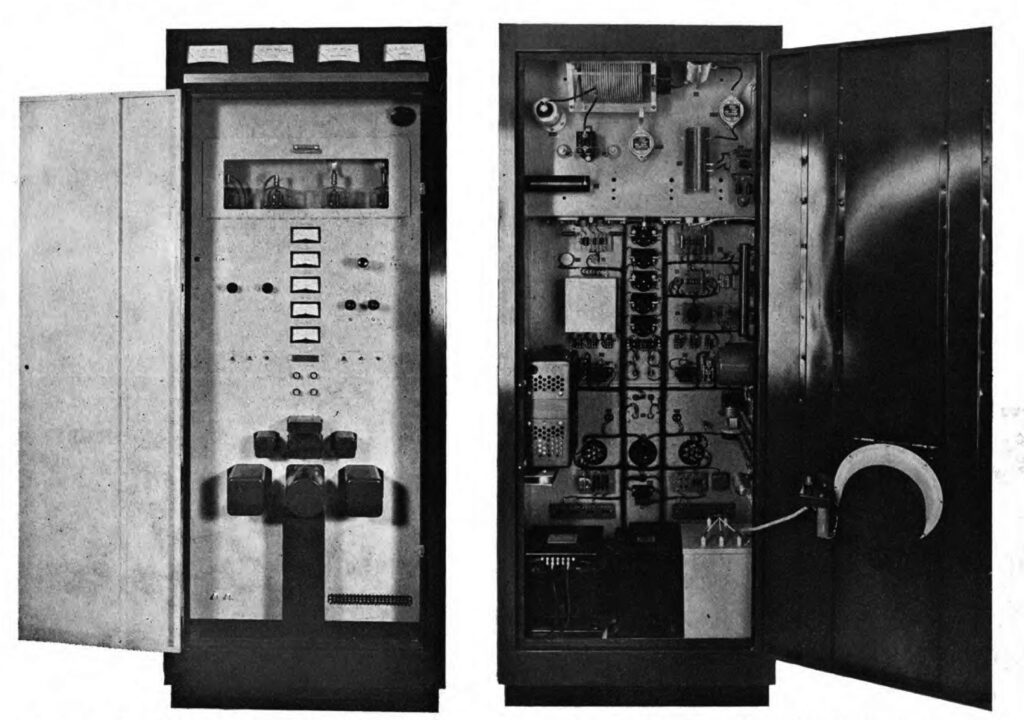
The Bauer 707 was originally designed as a kit for broadcast engineers, which makes its layout and documentation relatively accessible for study. Converting such a vacuum-tube transmitter for amateur radio service is a significant technical undertaking, which is a good reason to do it!
General areas of modification typically include:
- Frequency Adjustment: Adapting the transmitter for the 160-meter or 75/80-meter amateur bands requires modifying the tuned circuits in the RF stages. This involves calculating new values for inductance and capacitance to allow the transmitter to resonate at higher frequencies than the standard AM broadcast band.
- Excitation: Vintage broadcast transmitters typically rely on a fixed crystal for operation on the assigned frequency. Modern conversions, however, often utilize Direct Digital Synthesis (DDS) to provide the frequency agility needed for amateur radio use.
- Audio Processing: Amateur radio regulations and standard practices require narrower audio bandwidth than commercial broadcasting. Modifications are usually made to the speech amplifier and modulation stages to restrict the frequency response to a range suitable for voice communication, typically between 300 Hz and 3,000 Hz.
The Bauer 707 transmitter was introduced in 1960 by Bauer Electronics (San Carlos, CA). The company was later acquired by Sparta Electronics (Sacramento, CA) and sold under the name “Sparta Bauer.” An updated version of the model 707 was introduced in 1970 that included several small changes to the original unit, including increased wattage of some power resistors.
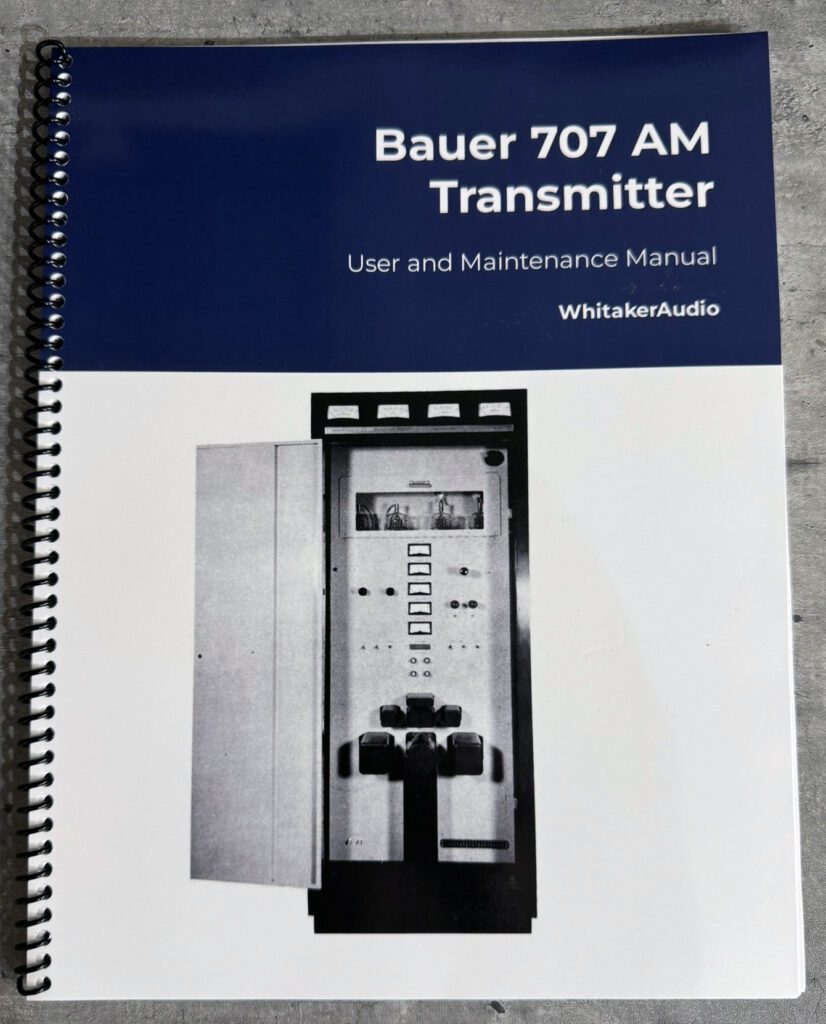
In preparation for this project, a manual was created that brings together all of the available documentation on the Bauer 707, including the following:
- Bauer AM Broadcast Transmitter Model 707 Instruction Book, Bauer Electronics, San Carlos, CA, September 1961.
- Bauer Model 707 Product Brochure, Bauer Electronics, San Carlos, CA (undated).
- “Design Features of a Broadcast Transmitter Kit,” Paul Gregg, Broadcast Engineering, Overland Park, KS, June 1960.
- Bauer Model 707 Assembly Instructions, Bauer Electronics, San Carlos, CA (undated).
- Sparta/Bauer AM Broadcast Transmitter Model 707 Instruction Book, Sparta Electronics, Sacramento, CA, July 1970.
The text above was developed in part from these documents.
The expanded Bauer 707 User and Maintenance manual is available for download on the Available Downloads page. A printed version is available for purchase on the Available Printed Documents page.
Updates will be posted here as the project gets underway…